


Commercial Real Estate Beyond the Noise: Market Realities and Dubai’s 10-Year Growth Arc
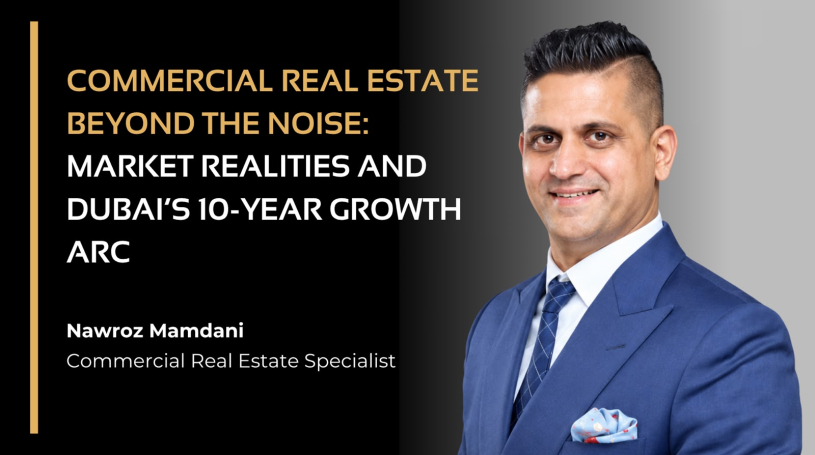
By Nawroz Mamdani | Commercial Real Estate Specialist for EurAsia Gulf
+971 55 612 0796
www.nawrozmamdani.ae
The True Picture: How Dubai’s Commercial Market Handled Regional Turbulence
When regional headlines escalated in early 2026, global boardrooms naturally paused to ask a fundamental question: How would Dubai real estate hold up under geopolitical strain?
For those looking closely at empirical data rather than speculation, the answer has been remarkable. Dubai’s commercial real estate sector didn't crumble; it demonstrated extraordinary operational continuity under pressure.
In the first half of 2026, total office transaction value reached AED 15.81 billion, nearly tripling the AED 5.34 billion recorded in H1 2025.
While transactional activity dipped briefly during March due to seasonal Ramadan timing and heightened regional caution, underlying business formation remained strong.
The Dubai Chamber of Commerce registered 2,709 new member companies in March alone, while the DIFC welcomed 775 new companies in Q1 2026, a 62% year-on-year increase. Capital didn't leave the market; it adapted and moved into quality.
Pre vs. Post-Conflict Market Shifts: Flight to Quality & Logistics Demand
Post-conflict market dynamics revealed a clear shift in buyer behavior.
Instead of speculative buying, investors and corporate occupiers prioritized "flight to quality" and long-term footprint security.
In Q1 2026, off-plan commercial sales captured 60.7% of total transaction volume, marking the first time since 2010 that off-plan sales surpassed ready transactions, as corporate buyers locked in future office space ahead of tight supply.
| Commercial Sector | Key Market Metric | Strategic Takeaway for Investors |
| Prime Grade A Office | DIFC & Downtown rents up +27% to +28% YoY; average sales prices up +20.1% YoY to AED 2,199/square feet | Tight vacancy in prime hubs gives landlords pricing power. Corporates are pre-leasing Grade A stock early. |
| Industrial & Logistics | Warehouse rental rates up +16.1% YoY across Dubai; Jebel Ali surged +20.9% YoY; renewals at 83.7%. | Supply chain security has made modern warehousing a top-tier defensive yield asset for institutional funds. |
| Development Pipeline | 86.2% of scheduled office supply is weighted for 2028 and beyond (1.13M sqm total pipeline). | Near-term supply remains constrained until 2028, insulating existing prime assets from oversupply risks. |
The 5-to-10 Year Outlook: Infrastructure, D33, and Strategic Positioning
Looking forward to the next 5 to 10 years, Dubai’s commercial real estate trajectory is anchored in the Dubai Economic Agenda D33, which aims to double the city’s economy and position it among the top three global cities. Three structural pillars will define the next decade:
1. Etihad Rail & Multi-Modal Mobility: Shrinking travel times between Dubai and Abu Dhabi to just 57 minutes transforms regional labor mobility and unlocks transit-oriented development (TOD) opportunities across secondary hubs.
2. Decentralized Business Districts: As prime CBDs operate near-capacity, emerging hubs like the RAW District in Downtown Jebel Ali and Motor City are expanding office supply and creating new commercial nodes.
3. Institutional Barbell Strategies: Institutional funds and family offices are adopting "barbell diversification” i.e., pairing high-growth Dubai commercial assets with stable, low-volatility international income assets to optimize long-term risk-adjusted returns.
In commercial real estate, navigating geopolitical cycles requires strategic architecture, not just sentiment.
Whether you are evaluating portfolio allocation, corporate relocation, or commercial acquisition in Dubai, reach out directly to Nawroz Mamdani to discuss how we can assist your organization in capitalizing on Dubai’s next decade of growth.