

Cross-Cultural Teams in the UAE: challenges or benefits?
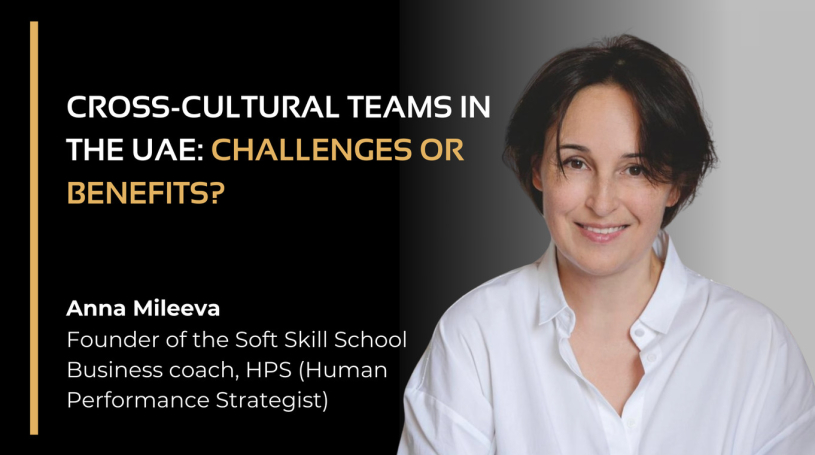
Author: Anna Mileeva
Founder of the Soft Skill School
Business coach, HPS (Human Performance Strategist)
Expert in Soft Skills assessment and development
Linkedin: https://www.linkedin.com/in/anna-mileeva-a11739286?
Dubai is one of the most international business environments in the world.
People from more than 150 countries work side by side here, representing hundreds of national and cultural contexts. For the UAE, this is not a trend and not an image element — it is a basic economic reality.
For owners and investors, this means one simple thing:
the team will almost always be cross-cultural, regardless of the industry and the size of the business.
Such diversity creates potential — and at the same time a systemic managerial challenge. And it is precisely how this challenge is understood that determines a company’s ability to grow sustainably.
Why business hits a ceiling not because of strategy, but because of culture
In practice, most problems in cross-cultural teams do not look dramatic.
Missed deadlines, lack of initiative, understatement, “formal agreement” without results.
But these symptoms rarely have a personal nature.
What we are dealing with is a mismatch of managerial logics.
In some cultures, a deadline is a rigid commitment.
In others, it is a reference point that can be adjusted as the context changes.
In some systems, hierarchy implies clear instructions and limited initiative.
In others, it implies autonomy and active expression of one’s position.
Even with a strong command of English, communication gets distorted:
directness may be perceived as pressure,
softness as uncertainty,
silence as agreement or, on the contrary, as a form of disagreement.
When these differences are not discussed and not structured, the business begins to lose manageability — quietly, without open conflicts, but with mounting operational losses.
Cross-cultural teams: a resource or a source of instability
Cultural differences in themselves do not make a business weak.
The problem is the absence of conscious management of those differences.
Research and practice show: with proper facilitation, diverse teams make more balanced decisions, adapt better to change, and demonstrate greater resilience in crisis periods. But this only works when differences are translated into clear managerial rules.
In the UAE context, cross-culturality is not a matter of tolerance or diversity for a checkbox.
It is a matter of business predictability.
What this means for owners and top management in the UAE
The main managerial mistake is to assume that business is universal and culture is secondary.
In practice, culture is what determines how strategies, KPIs, and managerial decisions are executed.
Companies that scale successfully in the UAE do several fundamental things.
What businesses should do specifically
1. Study cultures as a managerial tool
In the UAE, cultural awareness is not theory and not a soft topic, but a basic managerial competence. Understanding how different cultures relate to power, time, responsibility, and feedback directly reduces operational losses.
2. Recognize and articulate your own managerial logic
Expecting that a leader’s style is “understood by default” is a mistake in a cross-cultural environment. If deadlines, initiative, or directness are fundamental for you, it is important not only to demand them, but to explain why they are critical for the business.
3. Create rules that take differences into account
Strong companies in the UAE do not try to neutralize cultural specifics. They create clear standards for communication, accountability, and decision-making that make differences manageable rather than conflict-prone.
Such rules do not restrict flexibility.
On the contrary, they restore control and predictability to the business.
Why this conversation is especially important now
In conditions of slowing markets and rising competition, the winners are not the most aggressive, but the most resilient managerial systems.
Cross-cultural teams become an indicator of the maturity of the business and its leader.
They show whether an owner is able not only to set strategy, but also to build an environment in which that strategy is executed without distortions.
Instead of a conclusion
A cross-cultural team in the UAE is neither a challenge nor an advantage by itself.
It is a mirror of a business’s managerial maturity.
And it is in this mirror that you can most often see whether the company is ready for real scaling.